요청하신 기사를 영어로 번역해 드립니다.
As of September 2023, interest rates in the United States are seeing a record-breaking increase. The 30-year fixed mortgage rate has exceeded 7%, and commercial real estate loan rates have reached their highest levels since 2007, the year the global financial crisis began.
In this environment, many building owners in Manhattan are facing the burden of debt repayment as their refinancing deadlines approach. On the other hand, cash-rich investors are leveraging this opportunity to acquire real estate under favorable terms.
One of the core principles of investing is “buy cheap, sell high.” And the factor that has the greatest impact on this is "timing." Personally, I am experiencing my third major cycle in the New York real estate market, following 9/11, the 2007 financial crisis, and the COVID-19 pandemic. In these situations, the investor's psyche simultaneously weighs "risk" and "opportunity."
If you wait because you think financial costs are too high due to rising interest rates, or because you believe the economy will worsen by the time rates eventually drop, you may miss out on great investment opportunities. In fact, many who wait until the market feels stable or invest when prices are already rising miss the chance to buy at an attractive price. Consequently, they often buy at a high price and fail to enjoy the full benefits of long-term price appreciation.
Timing is also crucial when it comes to selling. Owners of financially stable buildings can withstand crises and wait for the market's next upswing, but those who cannot face the combined burden of rising vacancy rates and interest rates, often ending up selling at the wrong time.
Real estate investment, particularly commercial real estate, requires a long-term strategy rather than a short-term view. Elements such as purchasing a building in a prime location, increasing its value by raising rents through renovation, managing it well, and preemptively blocking vacancy risks are all vital. However, I believe the choice of transaction timing takes precedence over all of these.
Below, we will take a closer look at this through actual real estate transaction cases in Manhattan.
120 MacDougal St., New York, NY 10012
View Location on GOOGLE (Click)
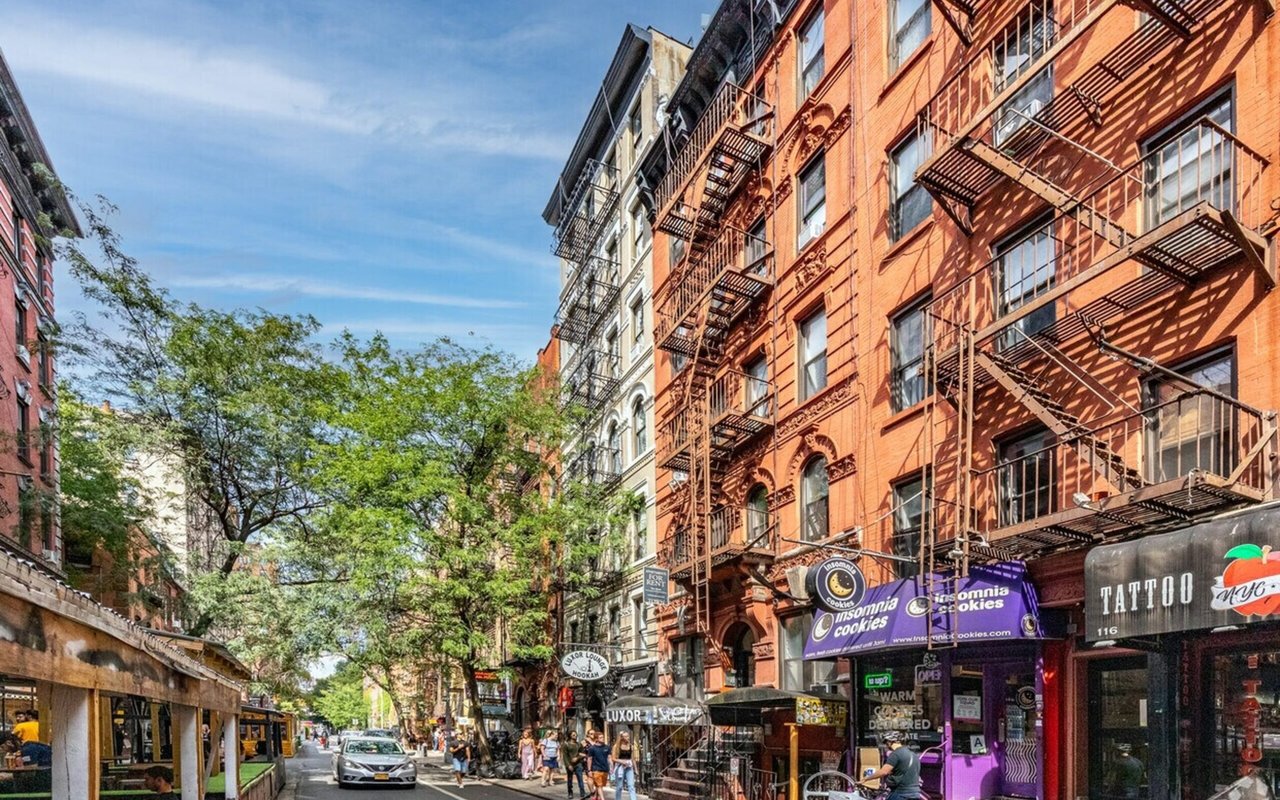
Located in the heart of Manhattan’s Greenwich Village, this 7-story building consists of retail on the first floor and residential units on the upper floors, with a total building area of 13,618 SF.
Built in 1910, the building features 26 one-to-two-bedroom residential units with monthly rents ranging from $3,000 to $4,000. Thanks to its excellent location and relatively affordable rent, new tenants typically sign contracts within a week or two even if a vacancy occurs.
There have been three transactions in the past 15 years, with the most recent occurring in June of this year. The transaction history of this building serves as an excellent illustration of the importance of investment timing.
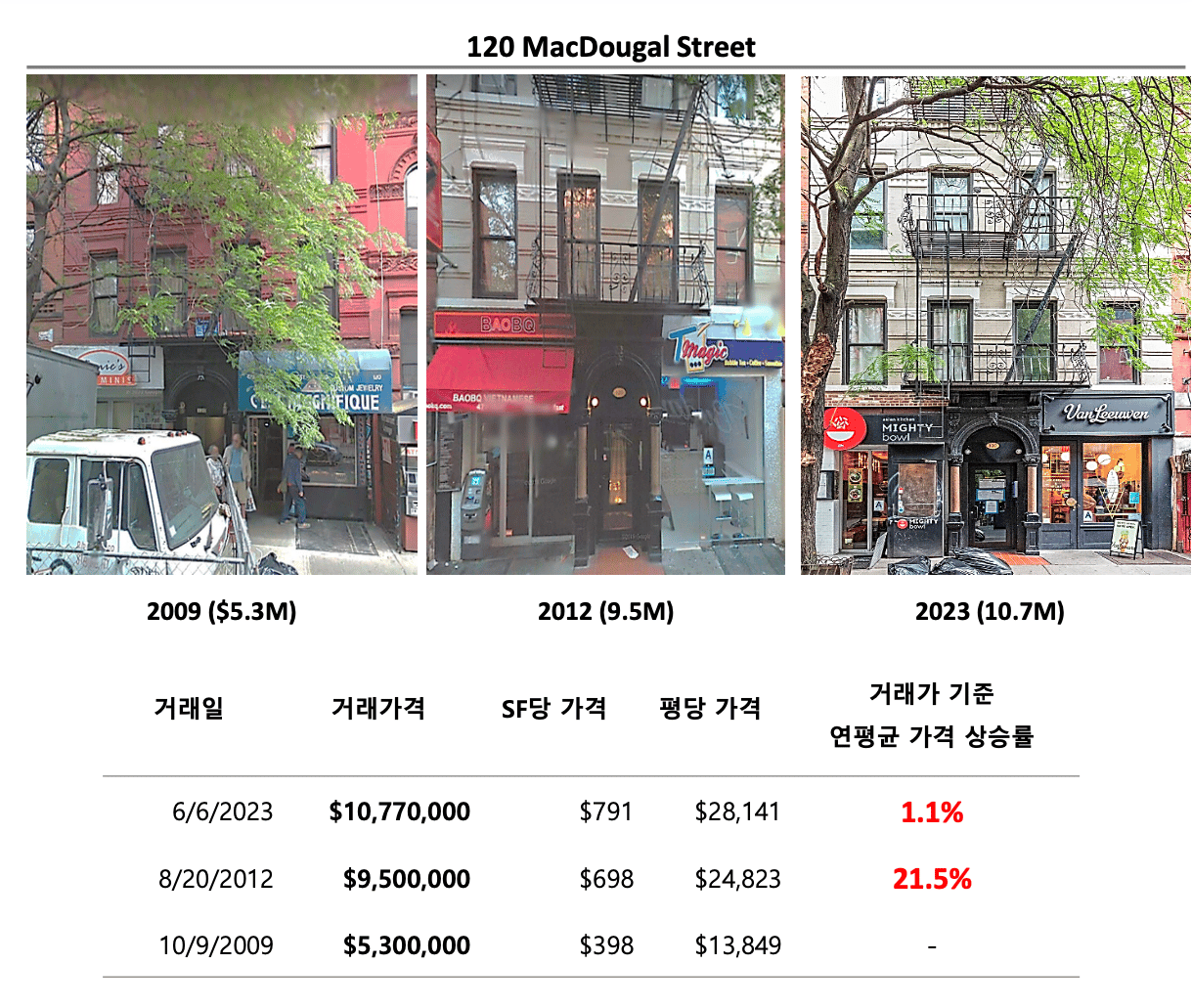
- In 2009, the building was purchased for $5.3M.
- Three years later, in 2012, it was sold for $9.5M, which is 180% of the initial purchase price. Through this transaction, the owner realized a high profit of $4.2M.
- The owner who acquired the building in 2012 held it for 11 years and sold it in June 2023 for $10.7M, only 113% of their initial purchase price.
The profit was a mere $1M, which becomes negligible when considering the actual transaction costs. It is easy to speculate that if they had sold in 2018, when the Manhattan market peaked, or if they could have outlasted the current interest rate crisis, they would have seen much higher returns.
The current real estate transaction trends in New York seem to show a very similar correlation between rising U.S. interest rates and building values seen around the 2007 financial crisis. Comparing the trends of U.S. commercial real estate prices with commercial mortgage rates makes the depth of this correlation even clearer.
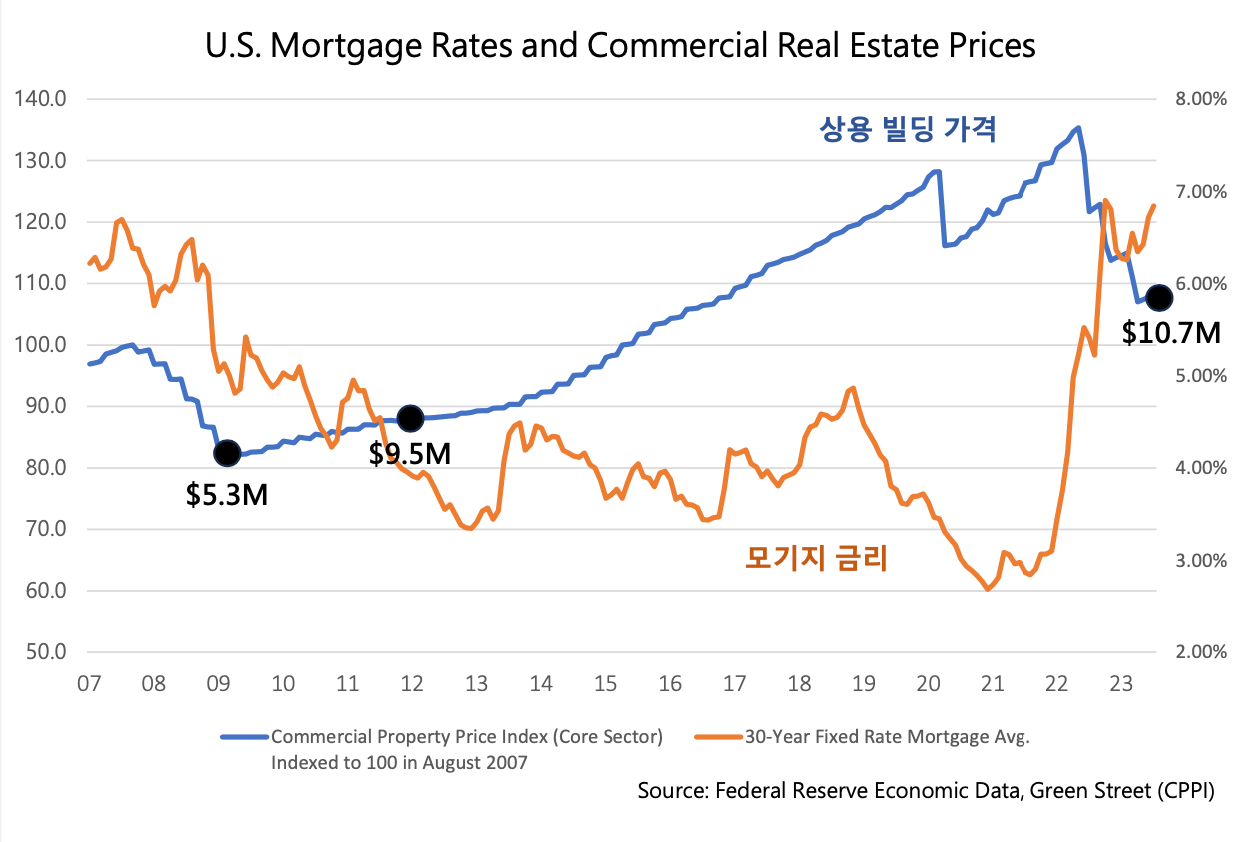
Cases demonstrating the importance of building transaction timing can be found throughout the cycles following the three major crises: 9/11, the financial crisis, and COVID-19.
609 5th Ave. New York, NY 10017
View Location on GOOGLE (Click)
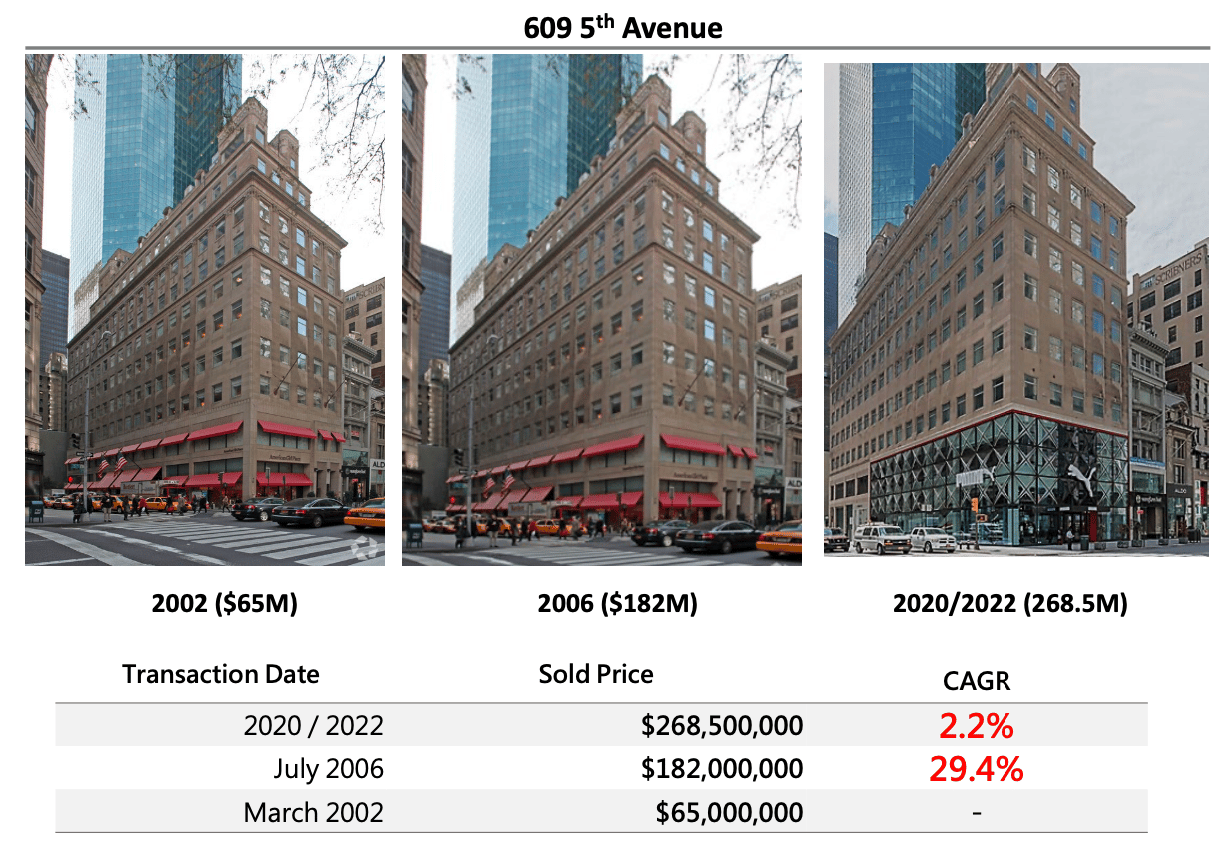
Immediately after the 9/11 attacks, Blackstone purchased 609 5th Ave. (the building where the PUMA flagship store is currently located on the lower levels) for just $65M. Four years later, in 2006, the building was sold to SL Green for $182M. Later, SL Green sold the retail and upper office spaces separately during the COVID-19 period (2020-2022) for a combined value of $268.5M.
Blackstone, which made the purchase during a time of wartime-like crisis (9/11) and held it for four years, saw a 280% return in just four years. In contrast, the performance of SL Green—which purchased during a period of market stability, held it for 16 years, and could not outlast the COVID crisis—does not seem nearly as impressive in comparison.
In fact, Manhattan building prices rose continuously from 2009 to 2018. During this period, buildings in popular locations like 120 MacDougal St. were almost impossible to find on the market. When such buildings did appear, they commanded high premiums, and some properties were traded at low yields, such as a Cap rate in the 2% range.
The current situation in the Manhattan real estate market appears to be a window of opportunity for investors with cash to discover undervalued assets in core areas and engage in value investing.